
Music is all around us, wherever we go and whatever we see in this digital world we listen to music. In the past, when viewers changed TV channels or listeners switched between CDs from different albums or artists, they often experienced significant variations in perceived loudness. This occurred because different audio sources were produced, mastered, and broadcast at different levels, requiring the listener to frequently adjust the volume control. This sudden jump in volume is not just annoying; it can actually ruin the listening experience for an audience. Creators and engineers struggled for years to find a fair way to balance these audio differences across different platforms. To maintain a standard and balanced audio level across all digital platforms, a uniform measuring scale was required. That is where LUFS (Loudness Units Full Scale) comes in as the universal standard for modern audio engineering. Understanding how this scale works is the secret to making your own audio sounds polished and professional on any device.
So, what is LUFS ?
LUFS (Loudness Units Full Scale) is the international standard for measuring the perceived loudness of digital audio. Unlike peak or RMS meters, LUFS reflects how loud audio sounds to the human ear by using K-weighting, which models human hearing sensitivity across different frequencies. It is widely used in music production, mastering, broadcasting, podcasting, film, and online streaming to maintain consistent playback loudness and ensure a balanced listening experience.
Types of LUFS
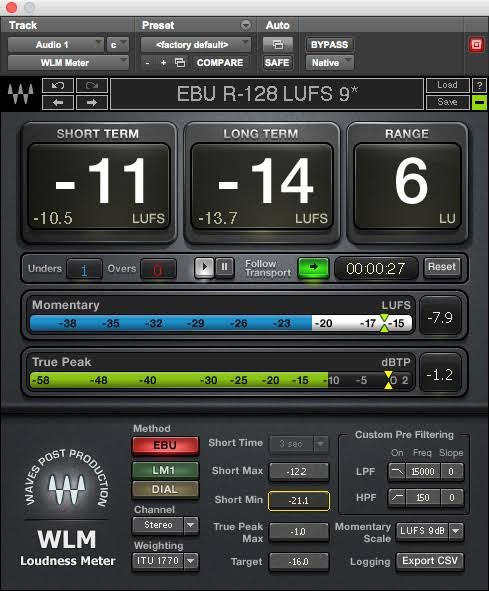
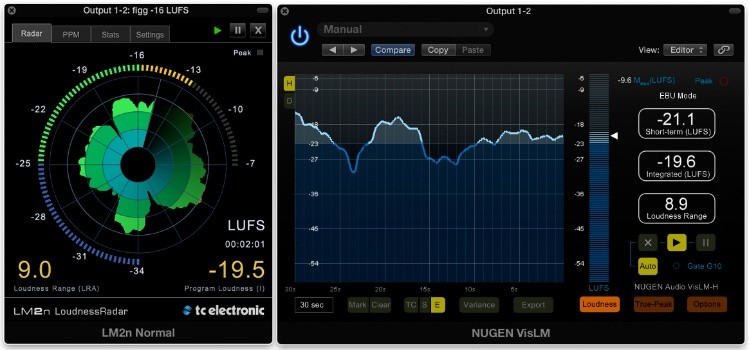
- Integrated LUFS (I) [Long-Term / Target Loudness]: Measures the average loudness of an entire audio file or song. Used as the primary loudness measurement for mastering. Example: A mastered song may have an integrated loudness of -14 LUFS.
- Short-Term LUFS (S): Measures loudness over a 3-second window. Useful for monitoring dynamic changes during different sections of a song (e.g., Verse vs. Chorus).
- Momentary LUFS (M): Measures loudness over a 400-millisecond period. Useful for tracking quick transients and sudden dynamic spikes.
Why LUFS Matters ?
- Consistent Listening: Ensures uniform volume across songs, programs, streaming and broadcasting loudness standards & reduces sudden volume differences between tracks. Reduces the need for excessive compression and limiting, preserving audio quality.
- Streaming Standards: Meets mandatory loudness targets across major platforms like Spotify, Apple Music, and broadcast networks. They use loudness normalization, so extremely loud masters may simply be turned down.
- Audio Quality: Prevents distortion caused by excessive gain and guards against clipping during lossy audio encoding (like MP3 or AAC). Overall, LUFS improves consistency, audio quality, and the listener’s experience.
How LUFS Transformed Audio Engineering
- Loudness War: Helped reduce the “Loudness War,” where recordings were heavily compressed to sound louder than others. Streaming services now automatically turn down tracks that exceed their loudness targets (e.g., a −8 LUFS master is turned down by 6 dB on Spotify). Because over-compressed tracks are attenuated, raw volume no longer offers a competitive edge.
- Preserved Dynamic Range: Engineers no longer need to crush audio with heavy limiters. Instead, modern mastering prioritizes dynamic depth, frequency balance, and punchy transients.
Online Streaming LUFS Scale
| Streaming Platform | Target (Integrated LUFS) | True Peak Limit |
| Spotify | -14 LUFS | -1.0 dBTP |
| YouTube | -14 LUFS | -1.0 dBTP |
| Apple Music | -16 LUFS | -1.0 dBTP |
| Amazon Music | -14 LUFS | -1.0 dBTP |
| Tidal | -14 LUFS | -1.0 dBTP |
| Deezer | -14 LUFS | -1.0 dBTP |
| Pandora | -14 LUFS | -2.0 dBTP |
| TikTok / Instagram | -9 to -12 LUFS | -1.0 dBTP |
Pros and Cons of LUFS
Pros:
- Uses K-weighting filters to measure perceived loudness.
- Gives engineers precise global targets (e.g., -14 Integrated LUFS) to ensure consistent playback volume.
- Supports loudness normalization on differences tracks.
- Helps audio engineers achieve industry-standard mastering.
- Preserves better listening quality by encouraging balanced dynamics.
- Solves the “Loudness War” byfixing boundaries to the loudness.
- Accurate Over Time: Measures long-term energy (Integrated LUFS) alongside short-term dynamics, capturing the true feel of full audio rather than transient spikes.
Cons :
- Does not measure peak levels, true peak meters are also needed to prevent clipping.
- Different streaming platforms requires slightly different loudness targets.
- Focusing only on LUFS can lead to miss other important aspects such as dynamic range, tonal balance, and overall sound quality.
- Audio with the same LUFS value can still sound different because of variations in frequency content and dynamics.
- Focusing on hitting -14 LUFS during mixing, can lead to unnatural gain staging.
- Strict LUFS targets treat a same for all genre of music, and lacks the dynamic needs.
- LUFS meter reading guarantees volume compliance, but it offers zero indication of mix translation, frequency balance, or sound quality.
Conclusion :
LUFS is an important standard for measuring the perceived loudness of digital audio. It helps the audio engineers maintain balanced loudness on all music, broadcasting, film, and online streaming. However, LUFS is a tool for volume compliance; not a replacement for a great mix.
LUFS plays a major role in modern audio production. To prevent ear damage caused by uneven loudness, audio engineers use LUFS to maintain a balanced level. Nowadays, LUFS plays a vital role in all professional studios.
Here at Soundpoint Pro, Chennai, you will learn professional Sound Engineering and Music Production from the fundamentals to advanced studio techniques. Get hands-on training in music recording, vocal and instrument recording, editing, mixing and mastering, along with professional audio level standards, gain staging, EQ, compression, reverb, delay, dynamics processing, stereo imaging and loudness management.
Our training covers the complete music production workflow, helping you understand how to achieve clean, balanced and industry-standard audio for music releases. Learn both the technical and creative aspects of studio engineering, from basic recording concepts to advanced mixing and mastering techniques, using professional studio equipment and audio production software.
Sound Engineering Course in Chennai, Audio Engineering Course, Music Production Course, Recording Mixing and Mastering Course, Studio Recording Course, Professional Mixing and Mastering, Music Production Training, Audio Engineering Institute in Chennai, Sound Engineering Institute in Chennai, Learn Music Production, Recording Studio Training, Mixing and Mastering Course, Professional Audio Production.